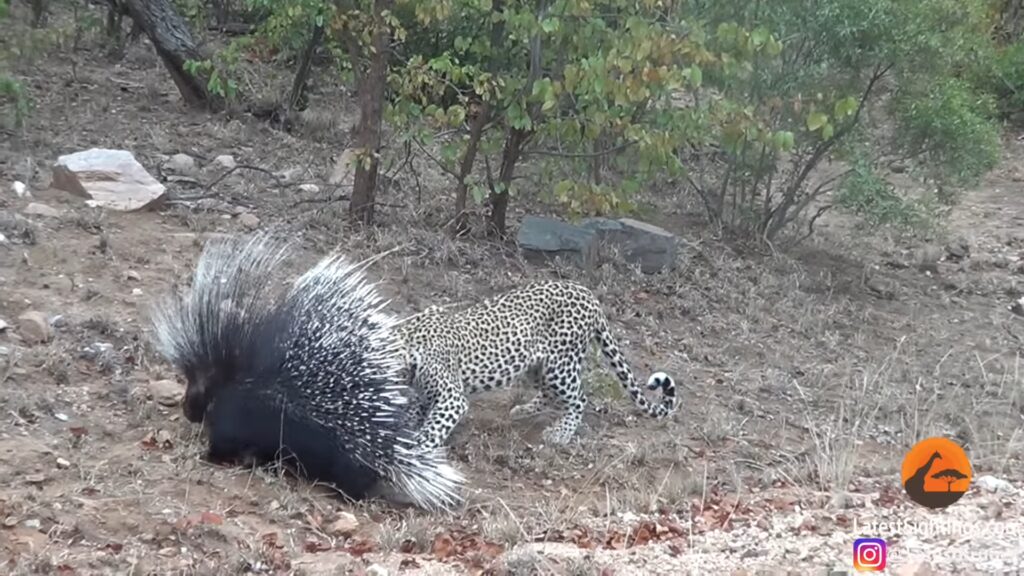
A young leopard in South Africa’s Kruger National Park discovered that not every potential meal is worth chasing.
The leopard came across a Cape porcupine and repeatedly tried to figure out how to get past its remarkable natural defenses. But every time the big cat moved closer, the porcupine turned its rear toward the predator and presented a formidable wall of sharp quills.
What followed was an unusual game of approach and retreat, with the leopard trying different angles and the porcupine calmly turning to keep its most dangerous weapons facing the predator.
The encounter was filmed by Ard van de Wetering during a visit to Kruger National Park. Contemporary reports identified the location as the northern part of the park, southwest of Shingwedzi.
A Leopard Spots a Porcupine
Ard van de Wetering and his wife were driving through Kruger National Park when they encountered the unusual pair.
According to accounts of the sighting, the family had been visiting the park for many years, but this was their first time witnessing a leopard and porcupine interacting in this way.
The leopard appeared interested in the porcupine and began following it.
For a young predator, the encounter presented a difficult challenge.
The porcupine was much smaller than the leopard, moved relatively slowly and appeared vulnerable.
But appearances were misleading.
The porcupine had one major advantage: its quills.
The Porcupine Turns Its Back
As the leopard approached, the porcupine immediately adopted a defensive position.
Instead of trying to run directly away, it turned its rear toward the leopard.
This was important because much of the porcupine’s back and rear is protected by long, sharp quills.
The leopard soon discovered that approaching from behind was not as simple as it looked.
Whenever it tried to move around the porcupine, the porcupine adjusted its position.
The leopard moved.
The porcupine turned.
The leopard tried another angle.
The porcupine turned again.
The encounter became an unusual dance between predator and prey.
The Leopard Keeps Searching for an Opening
The young leopard did not immediately give up.
It cautiously followed the porcupine and occasionally moved close enough to investigate its defenses.
According to Earth Touch News, the leopard appeared inexperienced with this particular type of prey and tentatively pawed at the porcupine’s spines while trying to understand how to get past them.
The porcupine, however, had a straightforward response.
It kept its quills pointed toward the leopard.
The predator could not easily reach the animal’s softer underside without exposing itself to the sharp defenses.
Why the Porcupine Was So Difficult to Attack
Cape porcupines (Hystrix africaeaustralis) are equipped with a combination of long quills and shorter defensive spines.
When threatened, they can raise their quills and use them to make an attacker think twice.
They can also rattle specialized hollow quills on their tails, producing a warning sound.
If the predator continues its approach, the porcupine can make a rapid backward charge.
Earth Touch News described this defense as particularly effective because anything directly behind the porcupine during such a charge risks being struck by the quills.
For the young leopard, that created a serious problem.
The Leopard Tries to Get Around the Quills
The leopard repeatedly looked for another way in.
It approached from different directions, apparently trying to find a position where the porcupine’s quills would not be pointing directly at it.
But the porcupine kept rotating.
This simple movement was remarkably effective.
The porcupine did not need to outrun the leopard.
It did not need to fight the predator directly.
It only needed to keep its defensive side facing the threat.
That made every approach difficult.
The Porcupine Sends a Warning
At one point, the porcupine became more assertive.
Rather than simply waiting for the leopard to approach, it moved toward the predator.
The porcupine could rattle its quills as a warning while making a quick backward movement.
This was enough to make the leopard reconsider getting too close.
The behavior was a clear defensive message: the leopard could investigate, but getting too close could be painful.
A Strange Wildlife “Dance”
The encounter continued with the two animals moving around one another.
The leopard would approach.
The porcupine would turn.
The leopard would search for another angle.
The porcupine would respond.
It almost looked like the animals were performing a strange dance on the road.
But there was nothing playful about the porcupine’s behavior.
The animal was protecting itself from a predator.
The leopard, meanwhile, was trying to work out whether the potential meal could actually be captured.
Contemporary coverage described the interaction as a back-and-forth encounter that eventually left the young leopard frustrated.
The Leopard Gets More Curious
The young leopard appeared unwilling to abandon the opportunity immediately.
It continued following the porcupine and investigating its defenses.
This is where experience can matter.
Porcupines are not necessarily impossible prey for leopards. Experienced predators can develop techniques for attacking them while reducing the chance of being struck by the quills.
Earth Touch News noted that successful porcupine hunting can require a leopard to know how to attack around the animal’s defenses rather than simply rushing in.
This young leopard did not appear to have mastered that technique.
The Porcupine’s Defense Keeps Working
Every time the leopard moved into a threatening position, the porcupine reacted.
The animal kept its quills between itself and the predator.
The leopard could not easily reach the porcupine’s vulnerable areas.
The result was a stalemate.
The predator had the advantage in speed, agility, claws and jaws.
The prey had a specialized defense that made those advantages difficult to use.
This is one of the fascinating things about predator-prey encounters.
Being bigger and stronger does not automatically make an animal easy to attack.
Why Leopards Need to Be Careful
A leopard is a powerful predator, but an injury can be costly.
A wound to the paw, face or mouth could interfere with hunting.
That matters for a solitary hunter.
Porcupine quills can cause serious injuries when they become embedded in a predator.
This is one reason experienced predators may be cautious when dealing with porcupines.
The goal of a hunt is to obtain food without suffering an injury that could make future hunts more difficult.
In this encounter, the young leopard appeared to be learning that lesson in real time.
The Leopard Eventually Lies Down
After repeatedly trying to find an opening, the leopard eventually seemed to lose interest.
Rather than continuing to attack, it lay down on the road and watched the porcupine.
The moment was almost comical.
The leopard had spent considerable effort trying to work out how to overcome a much smaller animal, only to end up resting while the porcupine remained nearby.
Reports of the encounter describe the leopard eventually becoming bored and moving away.
The Porcupine Doesn’t Need to Win a Fight
One important detail about this encounter is that the porcupine did not need to defeat the leopard.
Its goal was simply to avoid being killed.
By presenting its quills and maintaining a defensive position, the porcupine made the leopard’s attack difficult and risky.
Eventually, the predator decided to leave.
From the porcupine’s perspective, that was enough.
Survival does not always require overpowering an attacker.
Sometimes the best defense is making the attack too costly to continue.
What Makes Cape Porcupines So Well Protected?
The Cape porcupine is Africa’s largest rodent and is well known for its impressive coat of defensive quills.
The quills are modified hairs made from keratin.
They are not fired at predators like arrows, despite a common misconception.
Instead, they work through close contact and defensive positioning.
A predator that tries to grab or bite a porcupine can end up with quills embedded in its skin.
The porcupine’s ability to turn its rear toward a predator makes those quills especially useful.
Can Leopards Actually Kill Porcupines?
Yes.
A porcupine’s quills are an effective defense, but they do not make the animal invulnerable.
Experienced predators can sometimes overcome the defenses.
Earth Touch News notes that research into recorded leopard-porcupine encounters indicates that leopards can successfully prey on porcupines, particularly when they have learned how to approach them effectively.
That makes this particular sighting more interesting.
The young leopard was not necessarily incapable of hunting a porcupine.
It simply did not find a workable method during this encounter.
A Young Predator Still Has Lessons to Learn
Young animals have to learn many of the skills they will need as adults.
For a leopard, that includes identifying suitable prey, judging risks and learning how different animals defend themselves.
This porcupine provided a particularly memorable lesson.
The leopard could stalk it.
It could follow it.
It could approach it.
But none of those actions solved the main problem.
The porcupine’s quills were always in the way.
The Encounter Ends Without a Clear “Winner”
Eventually, the two animals went their separate ways.
The leopard abandoned its attempts, while the porcupine remained safe.
When van de Wetering eventually left the area, the porcupine was still sitting in the middle of the road, while the leopard had moved on to chase nearby antelope. It was not known whether the leopard later returned to the porcupine.
There was therefore no dramatic final attack.
Instead, the encounter ended with the predator deciding that this particular opportunity was not worth pursuing.
Watch the Leopard vs. Porcupine Encounter
The original footage is the same remarkable encounter captured by Ard van de Wetering in Kruger National Park.
Watch the video:
Watch “Silly leopard taking on porcupine at high speed will make your day!” on YouTube
The footage shows the young leopard repeatedly approaching the porcupine and attempting to find a way around its quills.
The porcupine responds by keeping its defenses pointed toward the predator and, when necessary, charging backward.
Related Wildlife Stories
If you enjoy unusual predator-and-prey encounters, you can also read these related stories on KHXYX:
- Cornered Bushpig Tries Fighting 5 Lions — A cornered bushpig repeatedly confronts a group of lions.
- 4 Porcupines Face 3 Lions on a Road — A group of porcupines uses its quills to discourage lions.
- Wildlife Animals Sharing the Same Habitat — More stories about fascinating wildlife behavior.
Replace these example internal URLs with the exact published URLs on your KHZYX site if your actual slugs are different.
More Information About Leopards and Porcupines
For readers who want to learn more about the animals involved, these external resources provide additional information:
- Earth Touch News — Young leopard and porcupine encounter
- Lowvelder — Leopard vs porcupine in Kruger National Park
- Good Things Guy — Young leopard and porcupine encounter
These sources provide independent background and reporting on the same encounter.
Final Thoughts
The young leopard may have approached the porcupine expecting an opportunity, but the encounter quickly became a lesson in defensive strategy.
The porcupine never needed to chase the predator away.
Instead, it repeatedly turned its most heavily protected side toward the leopard. Whenever the big cat searched for another angle, the porcupine adjusted. When the leopard pushed too close, the porcupine could rattle its quills and make a quick defensive charge.
The result was a remarkable standoff.
The leopard had speed, claws and powerful jaws, but the porcupine had an armor system specifically suited to discouraging predators.
After repeated attempts, the young leopard eventually lost interest and moved away.
For the porcupine, simply standing its ground was enough.
And for the people watching from the safari vehicle, it became an unforgettable example of how even a much smaller animal can make a powerful predator think twice.