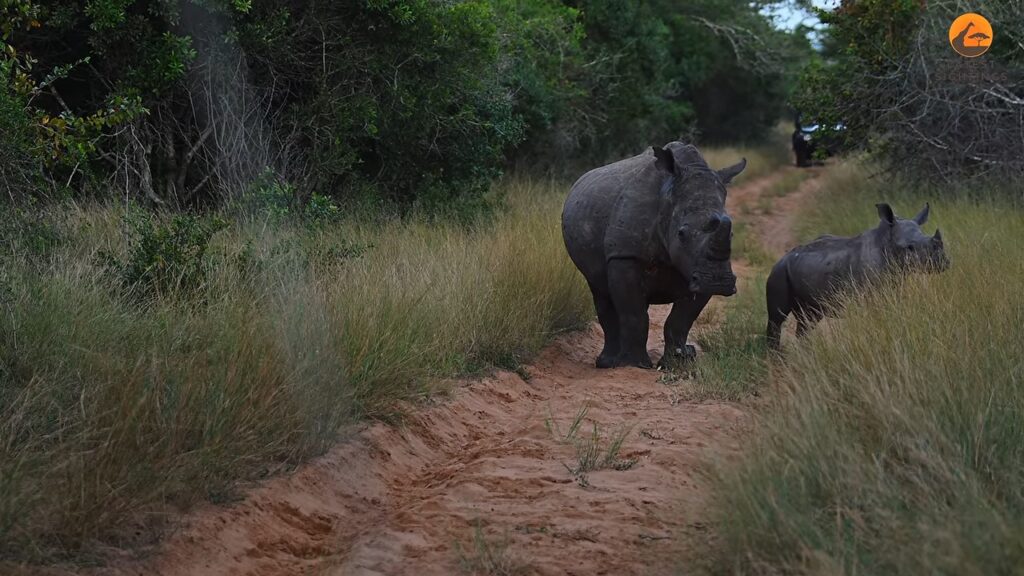
A dusty road in South Africa became the scene of an unusual wildlife encounter when a rhino mother and her calf approached a pride of around 10 lions resting directly in their path.
The lions initially appeared completely comfortable. Some were lying on the road while others watched the approaching rhinos. But as the two rhinos came closer, the lions began moving out of the way.
Then something even more entertaining happened.
With his mother nearby, the young rhino decided to deal with one of the remaining lions himself.
The calf moved toward the lion and helped clear the road, creating a remarkable moment that made it look as though the smallest member of the rhino family had decided that the road belonged to him.
The encounter was filmed by wildlife photographer Dylan Royal of &Beyond at Phinda Private Game Reserve and published by Latest Sightings in August 2026.
A Pride of Lions Takes Over the Road
The encounter begins with a large group of lions relaxing on a dusty road.
There is no obvious sign of urgency among the pride. The lions appear to be resting and watching their surroundings.
Roads in African reserves can provide convenient, open areas for wildlife to move through or rest on, and this pride had settled directly in the path.
Then the situation changed.
Two enormous shapes began approaching in the distance.
A rhino mother and her calf were walking toward the pride.
The lions had plenty of time to see them coming.
The Rhinos Keep Walking Forward
The adult rhino does not appear to be interested in stopping.
She continues walking toward the lions with her calf close by.
The closer they get, the more obvious the size difference becomes between the young rhino and the lions.
But the calf has an enormous advantage.
His mother is right beside him.
A rhino mother can be extremely protective of a calf, and predators have to consider the danger of getting too close to an adult rhino.
The lions seem to understand this.
Rather than waiting until the rhinos reach them, members of the pride begin moving away from the road.
One Lion After Another Moves Away
The approaching rhinos create a chain reaction.
The younger lions move first, clearing the path as the rhinos come closer.
Other members of the pride follow.
The road that had been occupied by a large group of lions gradually becomes empty.
The rhinos continue walking.
They don’t need to chase most of the lions.
Their presence is enough to make the predators move.
According to the footage’s description, the protective mother was clearly intent on moving the lions along, while the calf eventually chased off some of the remaining lions himself.
The Calf Watches the Remaining Lions
As most of the pride disappears from the road, one or more lions remain nearby.
This is when the young rhino appears to become more confident.
The calf is no longer simply following its mother.
It begins moving toward the remaining lion.
The sight is almost comical.
A young rhino is approaching a predator that is capable of hunting other large animals.
But the lion does not appear interested in testing the situation.
The rhino keeps coming.
The lion moves away.
The Baby Rhino Charges
The calf suddenly takes matters into its own feet.
It moves toward one of the remaining lions, forcing the predator to give ground.
The lion quickly leaves the road.
For a moment, it looks as though the young rhino has personally cleared the final obstacle from the path.
Of course, the calf has the protection of its mother close behind it.
That makes this encounter very different from a lone young rhino confronting a pride of lions.
The lions are not simply dealing with a calf.
They are dealing with a calf accompanied by a large adult rhino.
Why Lions Avoid a Close Confrontation
Lions are powerful predators, but attacking a rhino is extremely dangerous.
An adult rhino can weigh more than a ton, depending on the species and individual, and its horn and sheer body mass provide formidable defensive weapons.
A lion attempting to attack an adult rhino risks being struck, trampled or seriously injured.
For a pride, the calculation becomes even more complicated when a calf is accompanied by its mother.
The potential reward has to be weighed against the danger.
In this encounter, the lions appear to decide that giving the rhinos the road is the safer option.
The Mother Rhino Sets the Tone
While the calf gets most of the attention in the video, the mother is an important part of the story.
She walks forward confidently while her calf remains close.
Her presence changes the situation.
The lions have little reason to take unnecessary risks with a large adult rhino protecting a young one.
This may also help explain why the calf appears so confident.
He is not completely alone.
His mother is right there.
The Calf Seems to Copy His Mother
Young animals learn by watching adults.
The rhino calf’s behavior in this encounter provides a fascinating example of how a youngster can appear to gain confidence from its parent.
The mother continues forward.
The calf follows.
The lions move.
Then the calf becomes more assertive and moves toward one of the remaining lions.
It almost looks as though the youngster has learned a simple lesson:
If Mom isn’t worried, maybe I don’t need to be worried either.
Of course, we cannot know what the rhino was thinking. But its behavior makes for an unforgettable wildlife scene.
Ten Lions Versus Two Rhinos
The numbers make the scene particularly striking.
There are roughly 10 lions on the road.
On the other side are just two rhinos.
Yet the lions gradually give way.
This is a good example of why counting animals alone does not tell the whole story.
Ten lions may sound overwhelming, but the situation is not a straightforward fight.
The adult rhino is a large, heavily built herbivore with powerful defensive capabilities, while the young rhino has an adult immediately beside it.
The lions have to account for the risks before making any move.
Rhinos Have Their Own Natural Armor
A rhino’s body is built for survival in a challenging environment.
Its thick skin provides protection, while its horn can be used as a defensive weapon.
Unlike the porcupine, which relies on thousands of specialized quills to discourage predators, a rhino uses its enormous body, horn and powerful movements as its primary defenses.
This difference is fascinating when compared with the young leopard vs. porcupine encounter we covered earlier.
The leopard had speed, claws and powerful jaws, but the porcupine had an armor system specifically adapted to make a predator think twice before attacking.
The rhino’s defense works differently.
It doesn’t need to hide behind spikes.
Its size alone changes the calculation.
Why a Rhino Calf Is Vulnerable
Although the calf looks confident in the footage, young rhinos are still more vulnerable than adults.
Lions can prey on young or vulnerable animals when conditions allow.
That is why the presence of the mother is so important.
The calf’s safest position is close to her.
If a predator attempted to separate a calf from its mother, the adult rhino could respond aggressively.
This is one reason predators may choose not to pursue an opportunity when a protective adult is nearby.
The Lions Know When to Move
The pride does not appear to panic.
Instead, the lions gradually clear the road.
This is an important distinction.
They are not necessarily being “defeated” in a fight.
There is no prolonged battle.
The lions simply choose not to challenge the approaching rhinos.
Wild animals constantly make decisions based on risk.
Sometimes the smartest response to a dangerous animal is simply to move away.
The Adult Male Also Gives Way
The footage also captures an adult male lion in the area.
As the rhinos approach, he gets up and moves away rather than remaining in their path.
This is another indication of how seriously the lions treat the approaching rhinos.
Even a large male lion does not automatically dominate every encounter.
Size, weapons and defensive behavior matter.
A lion can be a formidable predator while still avoiding a confrontation with a dangerous herbivore.
The Last Lion on the Road
After most of the pride has moved away, one lion remains.
This creates the funniest moment of the encounter.
The young rhino appears to take responsibility for clearing the final obstruction.
The calf moves toward the lion.
The lion responds by leaving.
The road is finally clear.
The rhino calf continues forward with its mother nearby.
For anyone watching the footage, it almost looks as though the calf has just announced that the road belongs to him.
“King of the Road”
The video’s title calls the young rhino the “king of the road.”
That is obviously a playful description rather than a literal biological title.
But it fits the scene.
The lions were occupying the road.
The rhinos approached.
The lions moved.
Then the calf chased away the last remaining lion.
By the end of the encounter, the rhino family had the road to themselves.
A Lesson in Confidence and Protection
The encounter is also a reminder that young animals can behave very differently when they have an adult protector nearby.
The calf’s confidence may have been influenced by its mother’s presence.
The mother provides a powerful deterrent to predators.
The calf can explore and react to the lions while remaining close to an adult capable of defending it.
This kind of parent-offspring relationship is an important part of survival in the wild.
Why the Lions Did Not Attack the Calf
It is tempting to watch the video and ask why 10 lions did not simply attack the young rhino.
The most obvious reason is the adult rhino.
The calf is not an isolated target.
Any lion approaching the young animal would potentially have to deal with the mother.
A mistake could result in serious injury.
The lions therefore have to consider not only the calf but also the much larger adult standing beside it.
The Road Belongs to the Rhinos — For Now
Once the last lion moves away, the rhino mother and calf continue down the road.
The encounter ends without a fight.
There are no dramatic injuries.
No animal is killed.
Instead, the scene ends with a simple change of position.
The lions move off.
The rhinos continue forward.
And the young calf appears to have learned that standing confidently beside Mom can make even a large group of predators give way.
What This Encounter Shows About Lions
The footage is a useful reminder that lions are not constantly fighting every animal they encounter.
Predators need to conserve energy and avoid unnecessary injuries.
A confrontation with a rhino can carry significant risks without guaranteeing a successful meal.
In this situation, the lions appear to recognize that the rhinos are not an easy target.
Their decision to move away is therefore a normal part of wildlife behavior rather than evidence that the lions are incapable of confronting rhinos.
What This Encounter Shows About Rhinos
Rhinos may spend much of their time grazing and moving through their habitat, but they can be formidable when threatened.
An adult rhino’s combination of mass, strength and horn gives it a powerful defensive advantage.
The young calf benefits from that protection.
This is one reason encounters between rhinos and large predators can be so interesting.
The animals are not simply competing for food.
They are constantly assessing one another.
Filmed at Phinda Private Game Reserve
The encounter was filmed by Dylan Royal of &Beyond at Phinda Private Game Reserve in South Africa.
The original Latest Sightings video was published on August 4, 2026.
Phinda is known for its diverse wildlife and safari experiences, making encounters between large African mammals a major attraction for visitors.
For Dylan Royal, having a camera ready at exactly the right moment captured a memorable scene that has since been viewed millions of times online. The YouTube listing currently shows more than four million views.
Watch the Rhino Baby Face the Lions
The original footage is only a couple of minutes long, but it captures the entire progression of the encounter: the lions resting on the road, the rhinos approaching, the pride gradually moving away, and the calf chasing away one of the remaining lions.
Watch the original video here:
Watch “Rhino Baby Teaches 10 Lions That He’s The King of The Road” on YouTube
The video is a great example of how quickly the balance of a wildlife encounter can change when a large herbivore approaches with its young.
Related Wildlife Encounters
If you enjoy unusual encounters between African predators and animals defending themselves, check out these related stories on KHZYX:
- Cornered Bushpig Tries Fighting 5 Lions — A bushpig repeatedly confronts a group of lions when escape becomes difficult.
- 4 Porcupines Teach 3 Lions That They’re the King of the Road — Four porcupines use their defensive quills to discourage three lions.
- Young Leopard Takes on a Porcupine — A young leopard discovers that a porcupine is much harder to attack than it looks
Learn More About Rhinos
Readers who want to learn more about rhinos can also explore reputable wildlife and conservation resources.
The IUCN Red List provides scientific information about threatened species and their conservation status.
The World Wildlife Fund also provides background information about rhinos, their habitats and the conservation challenges they face.
For more information about wildlife in South Africa, the South African National Parks website provides information about protected areas and the country’s national parks.
Final Thoughts
The encounter between a rhino mother, her calf and a pride of around 10 lions is a remarkable example of how wildlife encounters do not always turn into fights.
The lions had numbers.
The rhinos had size, strength and the protection of an adult mother.
As the rhinos approached, the lions gradually cleared the road.
Then the young calf appeared to take things one step further.
With its mother nearby, it moved toward one of the remaining lions and helped clear the final obstacle from the road.
The lion moved away.
The rhino family continued forward.
The young calf may not literally have been the “king of the road,” but for those few moments at Phinda Private Game Reserve, it certainly looked as though he believed he was.
And perhaps the funniest part was that he had plenty of backup standing just behind him.