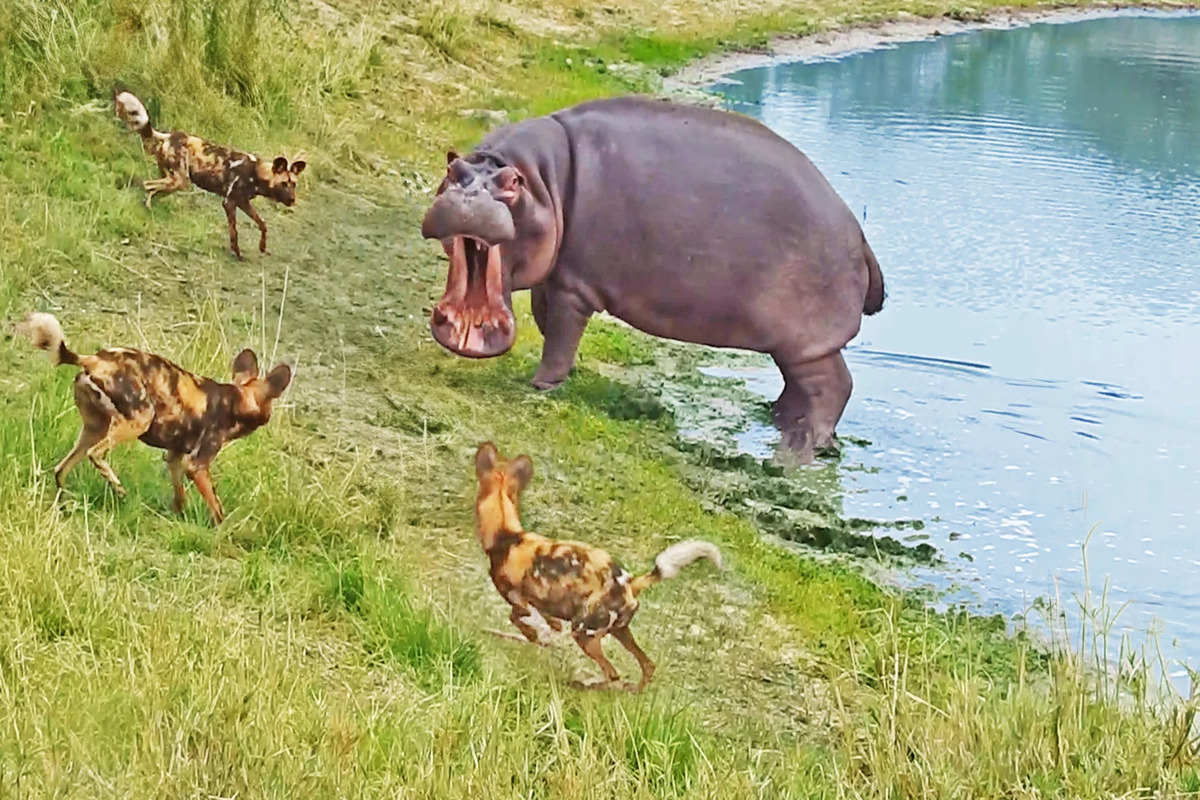
The wild dogs had gathered alongside a waterhole in the park. The pack members were filled with buzzing zeal and curiosity.
Playful wild dogs explore water’s edge
The wild dogs had gathered alongside a waterhole in the park. The pack members were filled with buzzing zeal and curiosity.
Wild dogs are naturally curious and highly inquisitive animals. They often investigate unfamiliar sights, sounds and smells, particularly when something catches the attention of the pack.
Their curiosity is closely linked to their social and cooperative nature. When one wild dog investigates something, others may follow, sniffing and examining it together.
Large hippo catches wild dogs’ attention
A large hippo, which was fiercely protective over this part of the waterhole, was making its way to the shore.
Hippos are highly territorial around water, where they spend much of their time. A dominant male will typically defend a stretch of river, lake or waterhole against rival males.
Male hippos communicate their presence through vocalisations, posturing and scent marking. They may also display aggression towards intruding males, especially when another male challenges their position.
Females and young hippos generally remain within the group rather than defending territories themselves.
While hippos can appear calm when resting in the water, their territorial behaviour can make them highly defensive when another animal enters their space.
These wild dogs were about to learn just how territorial a hippo can be! Once the hippo had waded sufficiently to the shore, it stood in the shallow waters and opened its mouth, threatening the wild dog pack away from its turf.
Hippo makes sure wild dogs don’t get too close!
As they edged close to the large animal, it opened its mouth in a furious display of intimidation.
For the pack, however, the confrontation provides an opportunity to investigate a powerful animal without necessarily committing to an attack.
Encounters like this demonstrate an important aspect of life in the bushveld. This is that size and strength are not always enough to make an animal ignore potential threats. At the same time, social predators do not always need to attack simply because they have numbers on their side.