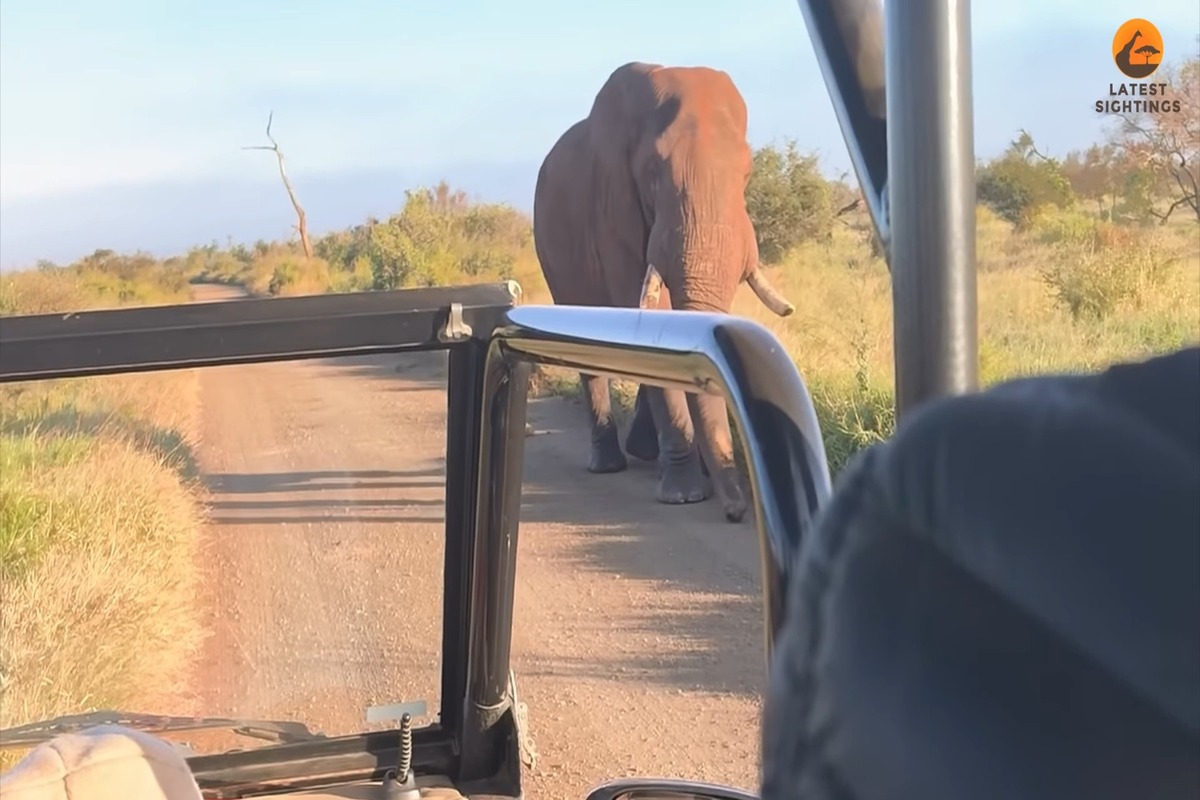
A peaceful elephant sighting can be one of the most unforgettable experiences on safari. Watching a huge African elephant bull calmly walk along a road while a safari vehicle waits nearby may seem completely routine.
But in Kruger National Park, one such encounter changed in just a few seconds.
On 22 May 2026, a bull elephant was walking calmly along the S137 when it passed a safari vehicle operated by the South Post at Kruger team. The guide had given the elephant plenty of room to continue along the road.
Everything appeared under control.
Then, as the elephant reached the front of the vehicle, the situation suddenly changed.
The bull bumped the vehicle, drove one tusk into the engine area and dragged the vehicle around and off the road. Thankfully, everyone inside escaped without injury.
A Calm Elephant Walking Down the Road
The encounter began in a surprisingly ordinary way.
The bull elephant was simply walking along the S137. Safari vehicles and elephants can sometimes share the same road, and the guide recognized that the elephant needed space to continue on its path.
According to the South Post team, the guide deliberately allowed the bull to pass rather than blocking its route.
For a while, the elephant remained calm.
There was no obvious indication that the encounter was about to become dangerous.
Then the bull reached the front of the vehicle.
The Moment Everything Changed
The elephant suddenly bumped the vehicle.
Almost immediately, the bull drove one of his tusks into the engine area.
The force was enough for the elephant to drag the vehicle around and off the road.
For the people inside, the change from a quiet wildlife sighting to a dangerous confrontation happened extremely quickly.
The video shows just how much power an adult elephant can bring to a vehicle without needing a prolonged charge.
The encounter was over relatively quickly, but the damage to the vehicle demonstrated the enormous strength of the animal.
Why Did the Elephant Suddenly React?
The exact reason for the bull’s sudden reaction is not completely clear.
The South Post account said the elephant appeared to get a fright after bumping the vehicle, but the bull was also reportedly in musth, an important factor in understanding the incident.
Musth is a natural reproductive condition in adult male elephants.
According to SANParks, bulls can enter musth for periods ranging from several days to several months. During this period, testosterone levels rise and bulls can become exceptionally aggressive.
That does not mean every musth bull will attack a vehicle.
It does mean that people should treat a bull showing signs of musth with particular caution.
What Is Elephant Musth?
Musth is not an illness.
It is a natural biological condition associated with reproduction in adult male elephants.
During musth, males experience major hormonal changes and become more sexually active. SANParks notes that musth bulls can dominate other potential mates and can be identified by secretions from the temporal glands and persistent urine dribbling.
This makes musth particularly important when interpreting an encounter like the one on the S137.
The elephant was not simply a normally calm animal that inexplicably became “evil.”
It was a wild bull in a particular physiological state, reacting to a situation that may have startled or challenged it.
How Can You Recognize a Bull in Musth?
Experienced safari guides look for several physical signs.
One of the most recognizable is fluid flowing from the elephant’s temporal glands, which are located between the eyes and ears.
Another sign is the constant dribbling of urine.
SANParks specifically advises visitors to watch for these signs because musth bulls can be quite aggressive.
The combination can provide an important warning that a bull should be given additional space.
But wildlife behavior can never be reduced to a simple checklist.
Even without obvious signs, an elephant can react unexpectedly if it feels threatened, startled, blocked or pressured.
Elephants Are Not Naturally Looking for Trouble
It is important not to interpret this incident as meaning elephants routinely attack safari vehicles.
The South Post team specifically said that they had previously experienced elephants and entire herds walking past their vehicles hundreds of times without interaction.
That is an important part of the story.
The encounter was unusual precisely because most elephant sightings do not end this way.
Elephants regularly encounter safari vehicles in areas where tourism takes place, but familiarity with vehicles does not make them domesticated animals.
They remain wild animals capable of responding with enormous force.
The Power of an Elephant Bull
An adult African elephant is an extraordinary combination of size, strength and mobility.
Its trunk can manipulate objects with remarkable precision, while its tusks can be used for digging, defense and fighting.
When an elephant puts its weight and strength behind a movement, even a large vehicle can be pushed, damaged or displaced.
That is exactly what made this encounter so dramatic.
The elephant did not need to overturn the vehicle to demonstrate its power.
A single tusk entering the engine area was enough to move the vehicle around.
The Guide Remained Calm
One of the most important details in the incident was the guide’s response.
According to South Post, the guide remained calm throughout the confrontation and handled the situation professionally.
That matters because panic can make a wildlife encounter even more dangerous.
A guide has to assess the animal, the vehicle’s position and the available escape route in a matter of seconds.
The goal is not to “win” against the animal.
The goal is to create distance and get everyone to safety.
The Elephant Dragged the Vehicle
The most remarkable part of the footage is the moment the bull uses his tusk against the vehicle.
The elephant pushed into the engine area and then dragged the vehicle around.
The vehicle moved under the animal’s force.
For viewers, it is an impressive demonstration of what an elephant can do when it decides to physically interact with something much smaller.
It also explains why keeping an appropriate distance from elephants is so important.
Kruger Has Specific Elephant Safety Rules
This type of encounter is one reason Kruger National Park has detailed guidance for visitors.
SANParks advises visitors to give elephants the right of way and not to follow them or cut off their path. It also specifically advises keeping a safe distance from bulls in musth.
The park’s general visitor rules also require guests to remain inside vehicles except in designated areas.
These rules are not designed to prevent people from enjoying wildlife.
They exist because the animals are wild and their behavior cannot always be predicted.
Giving Elephants the Right of Way
An elephant walking along a road is not necessarily an obstacle.
The road may simply be part of the animal’s route.
SANParks’ guidance is clear: visitors should allow elephants the right of way and avoid cutting off their path.
That principle is especially important with a bull.
If the elephant wants to continue forward, the safest response is generally to provide enough room for it to do so rather than forcing it to move around a vehicle.
When a Wildlife Encounter Looks Completely Normal
This incident is a useful reminder that a calm appearance does not guarantee a predictable outcome.
The bull was walking calmly.
The vehicle gave him room.
Nothing appeared particularly unusual.
Then, within moments, the elephant interacted forcefully with the vehicle.
That does not mean the guide necessarily made an obvious mistake. The original account itself describes the event as an unpredictable incident and says the guide had given the elephant plenty of space.
Sometimes wild animals simply react in ways that humans cannot fully anticipate.
Elephants Communicate With More Than Sound
Elephants use a combination of body movements, vocalizations and physical displays to communicate.
SANParks explains that elephants can use their trunks, ears and head movements to signal aggression. Threat displays can include spreading the ears, raising the head and tusks, head-shaking and trunk-swishing.
Elephants also produce rumbles, growls, bellows and trumpets, with some low-frequency rumbles traveling long distances.
Understanding these signals can help guides and visitors recognize when an elephant is becoming uncomfortable.
But recognizing warning signs is not the same as being able to predict exactly what will happen next.
A Mock Charge Is Not Always an Attack
Elephants sometimes run toward a perceived threat without following through.
SANParks notes that many elephant charges are mock charges and stop before the animal reaches its target. However, an elephant can also follow through with an attack and is capable of seriously damaging vehicles.
That distinction is important.
A person watching a video might see an elephant approaching a vehicle and assume the animal is definitely going to attack.
In reality, elephant behavior can involve assessment, warning, intimidation and retreat.
The safest response is still to treat the animal’s behavior seriously.
This Was Not a Predator Attack
Unlike many of the wildlife encounters featured on KHZYX, this incident did not involve a hunt or a predator.
There was no lion chasing prey.
No leopard stalking another animal.
No crocodile waiting beneath the water.
Instead, the danger came from an enormous herbivore that suddenly decided the vehicle was something it needed to push against.
That makes the footage particularly valuable for understanding another side of African wildlife.
Danger in the bush does not always come from predators.
Another Reminder From African Wildlife
The incident also fits a broader pattern seen across wildlife encounters.
Animals do not need to be predators to be dangerous.
A hippopotamus, rhinoceros or elephant can cause enormous damage when it feels threatened or reacts defensively.
That is why a safari is fundamentally different from visiting a zoo.
There may be a vehicle between people and the animals, but there is no invisible boundary controlling what the animal will do.
The animal remains in its own environment.
Fortunately, Everyone Was Safe
The most important part of the story is what did not happen.
Nobody was injured.
The South Post team confirmed that there was not even a scratch on anyone inside the vehicle.
The vehicle was damaged, but the people involved were safe.
For a situation involving a large elephant bull striking a safari vehicle with a tusk, that outcome was extremely important.
The Bigger Lesson From the Encounter
The incident offers a simple lesson for anyone watching wildlife.
A calm animal should still be treated as a wild animal.
An elephant walking peacefully beside a vehicle may remain completely uninterested in the people inside.
But circumstances can change.
The animal may become startled.
It may feel blocked.
It may be experiencing musth.
Or there may be something happening that the people watching cannot detect.
Respecting the animal’s space is therefore more important than trying to predict exactly what it will do.
Other Unpredictable Wildlife Encounters
This elephant encounter fits naturally alongside several other KHXYZ stories where an apparently simple wildlife interaction suddenly became dangerous.
In Hidden Crocodile Bites at Leopard From Below, a leopard moving across rocks near a dead hippo suddenly found itself facing a hidden Nile crocodile.
A young leopard taking on a porcupine also discovered that even a seemingly manageable encounter could turn painful in an instant.
And in Cornered Bushpig Tries Fighting 5 Lions, a small and heavily outnumbered animal found itself in an extremely dangerous confrontation with a group of lions.
These encounters are different, but they share one important feature: wildlife can change the situation faster than people expect.
Watch the Original Video
You can watch the original “Calm Elephant Bull Turns Aggressive in a Second” footage on YouTube.
The footage was published by Latest Sightings on 23 May 2026 and documents the incident from the previous day on Kruger’s S137.
Final Thoughts
The sighting began like hundreds of other safari encounters.
A bull elephant was walking down a road.
A safari vehicle gave him space.
Everyone appeared to be watching a calm and routine wildlife moment.
Then everything changed.
The bull suddenly struck the vehicle with one tusk, pushed into the engine area and dragged the vehicle around. The animal was reportedly in musth, a natural condition in which adult bulls can become considerably more aggressive.
Fortunately, the guide remained calm and everyone inside the vehicle escaped unharmed.
The encounter is a powerful reminder that wild animals do not follow a script. Even when an animal appears completely relaxed, its behavior can change in a matter of seconds.
In the African wilderness, respect and distance are not optional details.
They are part of staying safe.