Kampong Cham, Cambodia — In early January, at the peak of Cambodia’s fishing season, Chea Seila was driving north along the Mekong River when her phone began to buzz. The call came from another part of the river’s vast watershed, hours away. A fisherman had just hauled in a 209-pound Mekong giant catfish.
Seila, a member of a national rapid-response team formed to rescue imperiled megafish, turned her car around. Within hours, she and her colleagues were on site—measuring, tagging, and eventually releasing the critically endangered fish back into the water. Then her phone rang again.
For species long thought to be disappearing, the surge is striking. Once abundant across the Mekong basin, giant fish were killed by overfishing, dams, and disruption to the regular rise and fall of water levels along the river. The Mekong, spanning six countries and supporting the world’s largest inland fishery, holds more megafish species than any river on Earth, some of which can grow over 600 pounds.

In recent decades, their numbers have collapsed.
But in Cambodia, conservationists have persisted, working closely with fishing communities and local government officials strengthening cooperation along the river. In late 2025, a national hotline; a Mekong Fish App; and a dedicated rapid-response team transformed scattered rescues into a coordinated national effort. From mid-November to early February, the team returned 92 large fish that had been unintentionally caught—24 Mekong giant catfish, 23 giant barb, 32 seven-striped barb, and 13 striped catfish—back into the waters, alive.
Why megafish started to disappear
Giant freshwater fish are among the most threatened animals on Earth. In some regions, populations of freshwater megafish—which Hogan defines as species that can grow to at least 200 pounds or six feet in length—have declined by more than 95 percent since 1970. One such leviathan, the Chinese paddlefish, which could exceed 20 feet, was declared to have gone extinct in the early 2000s.
:max_bytes(150000):strip_icc():focal(719x609:721x611):format(webp)/stingray-cambodia-3-20051e4cdea14783bbc0d266146f19c5.jpg)
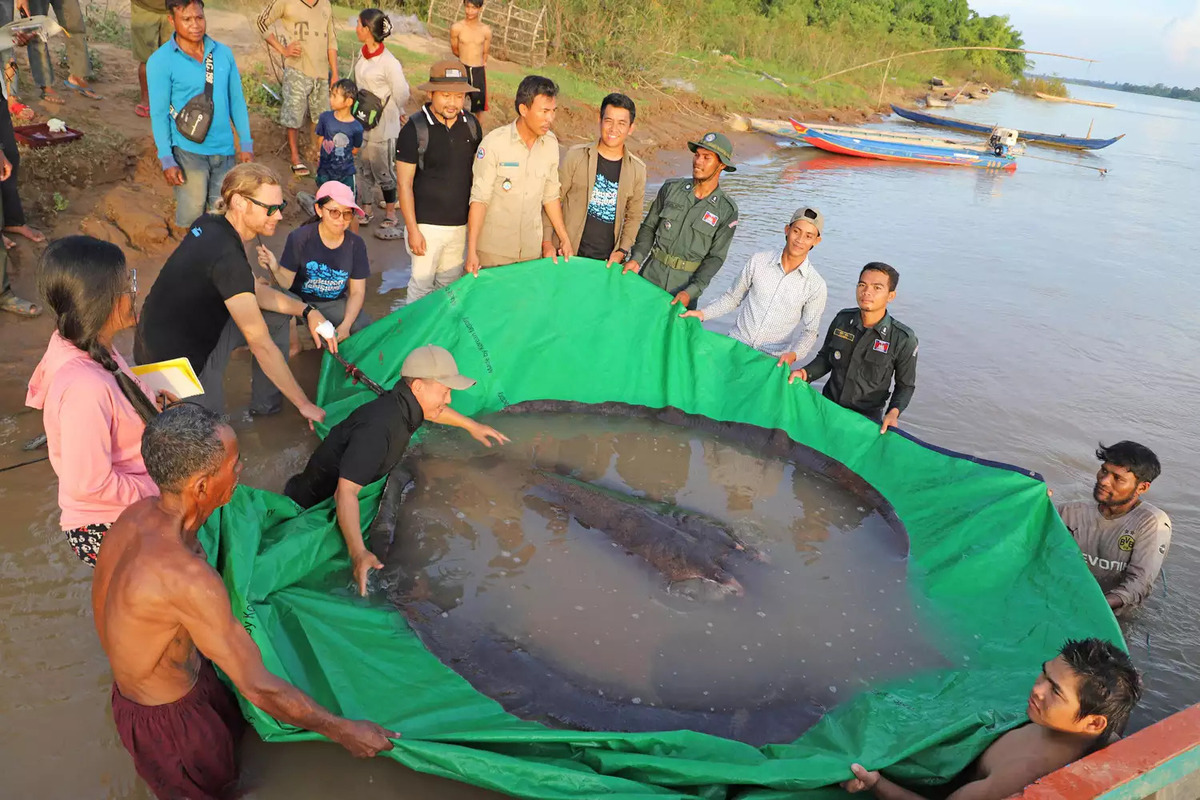
The reason the Mekong holds more megafish than any other river is likely because its immense size, productivity, and annual floods create the food, space, and connectivity that allow fish to grow extraordinarily large. In 2022, a giant freshwater stingray weighing a confirmed 661 pounds was caught and released in northern Cambodia, the largest freshwater fish ever recorded.
“If you’re looking for the planet’s freshwater giants, you look to the Mekong,” says Hogan.
In the early 1980s, the Mekong’s giants were commonplace in Kampong Cham, Cambodia. Huot Uong, now 73, recalls working on crews that hauled seine nets more than 2,000 feet long and 15 feet deep from the river. Each sweep could bring hundreds of striped catfish along with as many as 10 adult Mekong giant catfish.