Two hungry jackals thought they had found an easy opportunity.
Instead, they encountered a snake that was far more difficult to deal with than expected.
Near Crocodile Bridge in Kruger National Park, a nervous jackal was moving through tall grass when safari-goers realized something unusual was nearby.
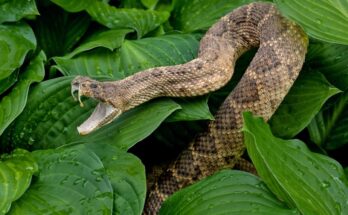
A huge python was lying coiled on the ground.
The first jackal approached cautiously.
Then another arrived.
The second jackal was much bolder. It moved toward the python and snapped at its body before quickly retreating.
But the python was ready.
It struck back.
What followed was a tense standoff in which two hungry jackals repeatedly tested a large python, only to discover that this snake was not going to become an easy meal.
Eventually, the jackals backed away and left the python to continue its retreat into the vegetation. The encounter was filmed by Jeaniene Joselowitz near Crocodile Bridge in Kruger National Park.
A Nervous Jackal Raises the Alarm
The encounter began with a jackal behaving strangely in the tall grass.
It was moving around nervously.
The people watching from the safari vehicle could tell that something had caught the animal’s attention.
The jackal did not seem comfortable.
It kept moving around as though it was trying to decide whether to approach or leave.
Then the reason became visible.
A Massive Python Was Lying in the Grass
As the vehicle moved closer, the observers spotted a large snake lying on the ground.
It was a python.
The snake was coiled and relatively still, making it easy to miss among the dry vegetation.
But its size immediately changed the situation.
This was not a small snake that the jackal could simply grab and carry away.
It was a powerful constrictor capable of defending itself.
The First Jackal Is Cautious
The first jackal began circling the python.
Its body language showed uncertainty.
It wanted to investigate.
It was also clearly aware that the snake could be dangerous.
The jackal moved closer, then backed away.
Closer again.
Then away.
It was essentially testing the snake without committing to a full attack.
Hunger Versus Caution
For the jackal, the python represented a potential food opportunity.
But getting food is not the only calculation a wild predator has to make.
It also has to consider injury.
A bite to the face or leg could make hunting difficult.
A serious wound could become life-threatening.
The jackal therefore had to balance hunger against risk.
Then the Second Jackal Arrives
The situation changed when another jackal appeared.
This second animal was considerably bolder.
Instead of carefully circling the python, it moved in toward the snake.
The first jackal had been hesitant.
The newcomer seemed willing to test the limits.
The Jackal Bites the Python
The second jackal suddenly lunged forward.
It snapped at the python’s body.
Then it immediately moved backward.
The attack was quick.
But the python responded even faster.
The snake struck back.
The jackal had discovered that this was not going to be a one-sided encounter.
The Python Fights Back
Pythons do not possess venom.
Instead, their main hunting weapon is constriction.
They seize prey with their jaws and then use their powerful bodies to restrain it.
But a large python does not need to be hunting to use its mouth defensively.
When threatened, it can strike rapidly.
That is exactly what the jackal encountered.
The Jackal Retreats
After the python responded, the jackal moved away.
For a moment, it looked as though the encounter might be over.
But hunger and curiosity brought the animals back.
The two jackals continued following the snake.
They had not completely abandoned the possibility of turning the python into a meal.
Both Jackals Begin Testing the Snake
The jackals moved around the python.
They approached from different angles.
They backed away.
Then they moved forward again.
Their strategy appeared to involve testing the snake’s reactions without getting too close.
It was a dangerous game.
One mistake could put a jackal within striking range.
The Python Remains Surprisingly Calm
The snake did not appear to panic.
Instead, it continued moving steadily through the grass.
That behavior may have helped discourage the jackals.
The python did not need to chase them.
It only needed to remain dangerous enough that the jackals could not safely grab it.
Why the Jackals Didn’t Simply Attack Together
Two predators working together can sometimes overwhelm a larger opponent.
But cooperation has limits.
If one jackal attacked from the front while the other remained nearby, the python could still strike either animal.
The snake’s body also gave it a major advantage.
A successful bite could immediately change the encounter.
For the jackals, there was simply too much risk for the potential reward.
The Python Was Not an Easy Meal
The original Latest Sightings report emphasizes that the jackals eventually realized the python was far too dangerous to pursue.
That is an important part of the encounter.
The jackals were not necessarily incapable of attacking.
They simply faced an opponent that could fight back.
And the potential food reward was not worth a serious injury.
Pythons Are Powerful Constrictors
Large pythons are among the strongest snakes in Africa.
They do not need venom to overpower prey.
Instead, they rely on muscular bodies and powerful jaws.
A large python can take surprisingly substantial prey when the opportunity arises.
That strength also makes an adult python a dangerous opponent for a much smaller predator.
A Jackal Is a Predator Too
The jackals were not helpless scavengers.
They are active and adaptable predators and scavengers capable of exploiting many different food sources.
Their willingness to approach the python reflects that opportunistic nature.
If an apparently vulnerable animal can be safely turned into food, a jackal may investigate.
But that does not mean it will continue once the risk becomes too high.
The Python Gives Them a Warning
The defensive strike was effectively a warning.
The python did not need to chase the jackals across the landscape.
Its rapid response demonstrated that getting close could have consequences.
The jackals understood.
They continued watching, but their approach became more cautious.
The Snake Starts Retreating
Eventually, the python began moving away through the dry grass.
It was not attempting to pursue the jackals.
It was simply trying to put distance between itself and the predators.
The jackals followed for a while.
But the longer the encounter continued, the clearer the outcome became.
Then More Animals Join the Drama
The confrontation attracted attention from another group of animals.
Several plovers began calling loudly nearby.
Their behavior added another layer to the encounter.
The birds appeared to be concerned about the python because they likely had a nest nearby.
Why Would Plovers React to a Python?
The plovers’ behavior makes sense if there was a nest or young nearby.
Ground-nesting birds are particularly vulnerable to predators that move through their nesting area.
A large snake could potentially pose a threat to eggs or chicks.
The loud calls may therefore have been an attempt to draw attention to the intruder or discourage it from approaching.
The exact motivation cannot be confirmed from the footage, but the original report notes that the birds appeared concerned about a nearby nest.
The Scene Becomes a Wildlife Traffic Jam
What began as two jackals investigating a snake had now attracted birds as well.
The python was moving through the grass.
The jackals were following.
The plovers were calling.
And the safari vehicle was watching the entire scene unfold.
It was a small example of how one animal’s movement can quickly affect several other species.
The Jackals Keep Their Distance
The jackals continued to follow the python, but they no longer looked as confident as before.
Their tails were held lower.
Their ears were back.
The animals were becoming increasingly cautious.
The potential meal was turning into a potential injury.
This Is the Risk of Scavenging
Jackals often make use of opportunities created by other animals.
But scavenging and stealing food can be dangerous.
Other predators may defend carcasses.
Large animals may attack.
And prey that appears vulnerable may suddenly fight back.
The python encounter demonstrates the same principle.
An easy meal is only easy if the cost of obtaining it remains low.
The Python Had an Unexpected Advantage
The python’s biggest advantage was not simply its size.
It was its ability to make the jackals hesitate.
Every time a jackal approached, the snake could strike.
That uncertainty prevented the jackals from confidently committing to the attack.
In predator-prey encounters, hesitation can be extremely important.
A Successful Defense Without a Fight
The python did not need to kill either jackal.
It did not need to overpower them.
It simply needed to make them decide that attacking was too dangerous.
That is a successful defense.
The goal of defensive behavior is often survival, not victory.
The Jackals Eventually Give Up
After several minutes of testing the snake, the jackals finally abandoned the confrontation.
Their tails remained low and their ears were back as they trotted away.
The potential meal was not worth the risk.
The python continued its steady retreat into the vegetation.
Sometimes Retreat Is the Smartest Choice
A predator that walks away from a potential meal has not necessarily failed.
Avoiding injury is often more important than obtaining one meal.
If a jackal gets badly injured while attacking a python, it could struggle to hunt or compete for food afterward.
Walking away allows it to search for another opportunity.
That is exactly what happened here.
The Python Wins by Surviving
It is tempting to describe the encounter as a battle with a winner.
But the more useful way to understand it is as a defensive success.
The python remained alive.
The jackals left.
The snake continued moving away.
The immediate threat had ended.
That was enough.
Kruger National Park’s Crocodile Bridge
The encounter took place near Crocodile Bridge in Kruger National Park.
Crocodile Bridge is located in the southern part of the park near the Crocodile River.
The area is known for wildlife viewing, and its riverine environment supports a wide range of species.
The dry grass surrounding the area provided the python with cover while also giving the jackals room to investigate.
A Rare Look at Predator Versus Predator
The most interesting part of this encounter is that neither side fits neatly into the usual predator-prey story.
The jackals were predators.
The python was also a predator.
Instead of one animal simply hunting the other, both animals were evaluating the risk of confrontation.
That makes the footage particularly interesting.
The Python Was Stronger Than It Looked
A snake lying quietly in the grass may not appear threatening.
But size matters enormously in constrictors.
The jackals learned that the hard way.
Their initial confidence disappeared once the python demonstrated how quickly it could strike.
The Jackals Had the Numbers
Two jackals had an advantage over a single snake in terms of mobility and the ability to approach from multiple directions.
But the python’s defensive ability offset that advantage.
If either jackal moved too close, it risked becoming the target of a powerful bite.
Numbers do not always guarantee success.
The Importance of Knowing When to Stop
The final decision by the jackals is perhaps the most important behavior in the entire encounter.
They stopped.
They recognized that the opportunity was becoming too dangerous.
Then they walked away.
Wild animals constantly make these kinds of risk calculations, even if we cannot know the precise thought process behind them.
The Python Continues Into the Bush
Once the jackals left, the python continued moving through the dry vegetation.
It had successfully avoided becoming a meal.
It had also avoided being forced into a prolonged confrontation.
The snake simply disappeared into the surrounding habitat.
No Clear Winner—But a Clear Outcome
There was no dramatic killing.
No prolonged wrestling match.
No animal was carried away.
Instead, the outcome was determined by behavior.
The jackals approached.
The python defended itself.
The jackals reconsidered.
The python escaped.
That is sometimes how wildlife conflicts end.
What This Encounter Teaches Us
The footage demonstrates several important lessons about survival:
- Size can discourage predators.
- Defensive strikes can create valuable distance.
- Predators do not attack every potential food source.
- Injury can be more costly than missing a meal.
- Animals often retreat when the risk becomes too high.
- Different species can become involved in the same encounter.
The jackals’ hunger brought them close.
The python’s strength kept them away.
Watch the Original Video
You can watch the exact footage here:
Watch “This Python was Too Strong for Hungry Jackals” on YouTube
The footage was filmed by Jeaniene Joselowitz near Crocodile Bridge in Kruger National Park and was published by Latest Sightings on December 27, 2025.
More Wildlife Encounters From KHXYZ
Predators do not always get what they want in the African bush.
In another remarkable encounter, four Cape porcupines stood their ground against three lions, using their defensive quills to make the lions reconsider the attack.
A baby warthog also escaped four lionesses with an incredible side step, showing how a small prey animal can survive by reacting at exactly the right moment.
And in another snake encounter, a huge bullfrog refused to become a meal for a boomslang, turning a seemingly easy hunt into a long struggle.
The African wilderness is full of moments where the expected outcome does not happen.